
Using AI Safely and Effectively: What Older Adults, Caregivers, and Senior Living Communities Should Know
Artificial intelligence (AI) tools like ChatGPT are becoming part of everyday life. While many people are still figuring out how and when to use AI, researchers are beginning to study how these tools can support older adults and family caregivers.
Recently, the Candoo Tech team participated in one of our regularly scheduled “Lunch and Learns” with subject matter experts. This time, we were joined by Dr. Stephanie Bennett of the Nell Hodgson Woodruff School of Nursing at Emory University, whose research interests include older adults' and caregivers' use of AI during their health information-seeking journeys. The discussion reinforced something we see more every day: AI can be a powerful tool when it is used thoughtfully and safely.
The Candoo Tech team took away some key information which they will share with clients in our one-on-one Tech Concierge sessions, group lessons (Chat GPT is one of our most popular topics) and in our own daily work.
Here are some of the key takeaways we believe can help older adults, caregivers, and senior living communities.
AI Can Save Time on Everyday Tasks
Caregiving often involves juggling information, appointments, paperwork, communication, and daily responsibilities. AI tools can help ease that burden by assisting with tasks such as:
● Drafting emails to family members, healthcare providers, or community staff
● Creating checklists and care planning templates
● Summarizing information and feedback from multiple sources
● Generating questions to ask doctors or specialists
● Organizing notes and reminders
Dr. Bennett partners with a family caregiving advisory board, where a key focus is on caregivers' use of AI. Most members report significant time savings from using AI as an assistant: for example: the time required to locate health information decreased from an estimated 45 minutes to under 2 minutes; and creating and updating daily schedules and tasks based on care plans developed with their providers went from taking about 25 minutes to being nearly instantaneous.
The key is to think of AI as an assistant, not an expert. It can help you get started, organize information, and save time—but human judgment is still essential.
TIP: You can share your chat with other family members or providers directly.
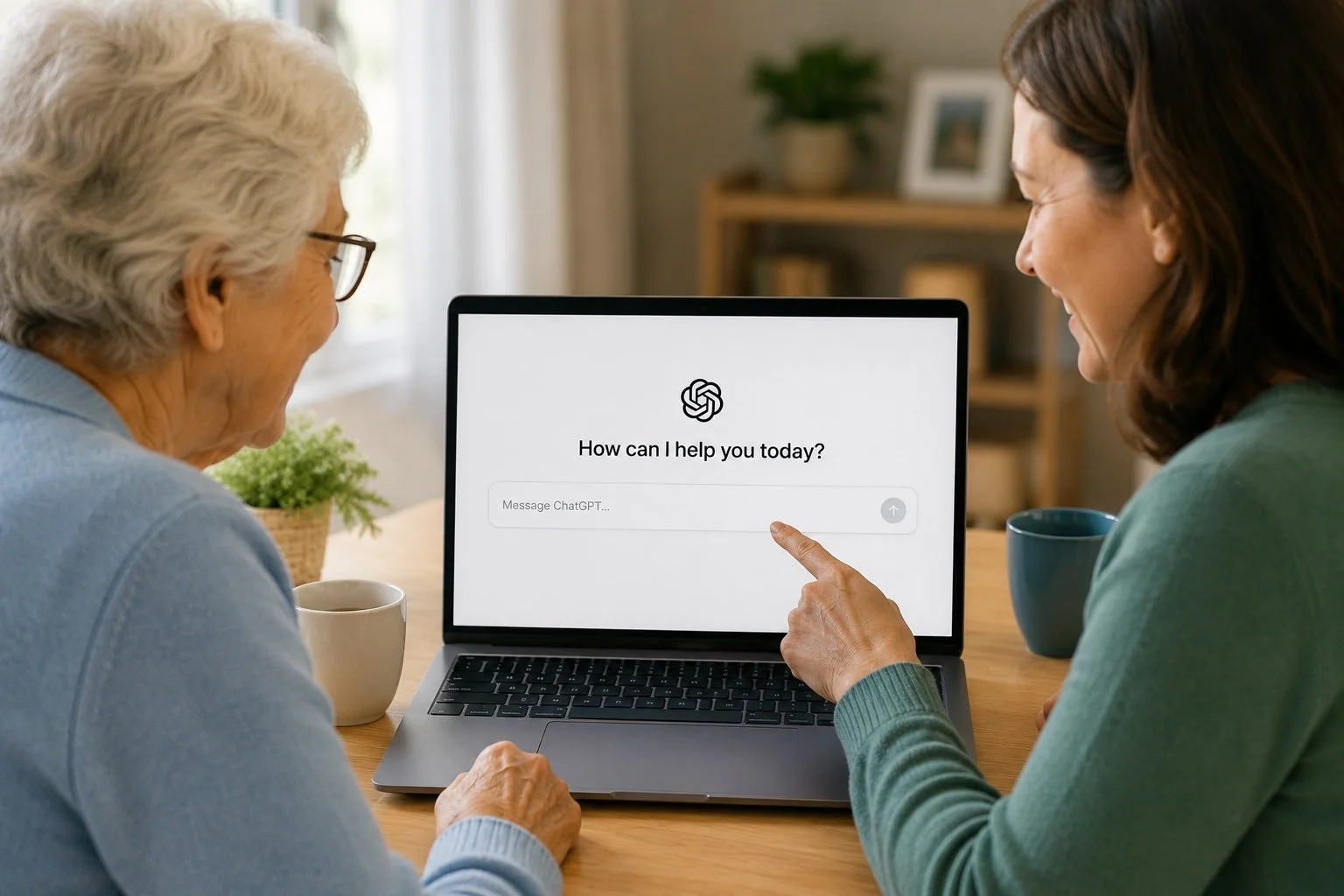
Use AI for Information Gathering—Not Medical Decision-Making
One of the most promising uses of AI is helping people find and understand health information.
For example, older adults may use AI to learn more about:
● Exercise recommendations
● Nutrition and healthy eating
● Diabetes management
● Cholesterol and heart health
However, researchers have found that older adults often want to verify health information provided by AI before acting on it—and that's a wise approach.
AI should never replace guidance from healthcare professionals. Any medical advice, diagnosis, medication changes, or treatment recommendations should always be discussed with a qualified, trusted healthcare provider.
Better Questions Lead to Better Answers
Many people assume AI either "works" or "doesn't work." In reality, the quality of the response often depends on the quality of the question.
A few simple tips:
If you know you like a particular tone or style (bulleted lists), consider updating your settings to include custom instructions about behavior, style and tone; and custom information about your occupation, interests, values and preferences
Improve the way that you phrase the question to improve the responses. It’s called “Prompt Engineering”.
Follow these tips for prompt engineering– think “RCRT”:
ROLE: Give Chat a role that you trust
CONTEXT: Give context and nuance: info about your loved one or the situation
REFERENCES: Help guide Chat GPT to trusted sources. Also, tell Chat GPT to cite its sources.
TASKS: Tell Chat how to display info or how to interact with you.
For example:
"You are a geriatric care specialist [ROLE]. My father has early-stage dementia and diabetes. He was recently discharged from the hospital [CONTEXT]. Please use information from the National Institute on Aging and the Alzheimer's Association [REFERENCES]. Create a table of questions our family should ask at his next doctor visit and categorize them by his conditions [TASKS]."
Protect Your Privacy
Another important topic discussed during our learning session was privacy and data security.
Before sharing personal information with any AI tool, consider:
● Does the tool save conversation history?
● Are you comfortable sharing this information?
● Is there a way to limit what is stored?
As a general rule, avoid entering sensitive personal, financial, or medical information unless you understand how the platform handles your data. In most cases, we don’t have much insight into how AI companies use our data.
TIP: Most AI tools offer privacy settings that can limit how your conversations are used to improve future AI models. Take a few minutes to review those settings before sharing sensitive information.
Remember: AI Is Not a Person
One of the most important cautions for older adults and caregivers is that AI is designed to sound conversational and supportive.
That can be helpful. But it can also create the impression that the technology understands emotions or has a personal relationship with the user.
Researchers studying older adults' experiences with AI have noted concerns about people becoming overly reliant on chatbots for companionship, especially when they are experiencing loneliness or social isolation.
AI can be a useful tool, but just as it cannot replace your healthcare team, it cannot replace family, friends or caregivers.
The best approach is to use AI as a resource while continuing to prioritize meaningful human interaction.
If you have more questions about using Chat GPT or other forms of AI, or need help implementing some of the tips here, reach out to support@candootech.com or schedule a session at www.candootech.com